🎓 I am an astrophysicist and researcher at the Department of Theoretical Physics and Astrophysics (DTPA), Masaryk University in Brno, Czech Republic, where I received my PhD in June 2026. I work in the High Energy Astrophysics (HEA) group led by Prof. Norbert Werner. My research focuses on AGN feedback in giant elliptical galaxies, with a specialisation in the detection and characterisation of X-ray cavities in the hot atmospheres of these galaxies. I work extensively on image and spectral analysis of X-ray observations and on applying machine learning methods to astronomical data.
💻 Beyond astronomy & astrophysics, I genuinely enjoy coding, and in my free time, I like to play with home automation projects 🏠🔌. When I step away from the screen, I play football ⚽, ride my bike 🚴, and spend time gardening 🌱.
09/2019–06/2021 — MSc, Relation between Bondi accretion and jets powers in giant elliptical galaxies (supervisor: Norbert Werner), DTPA, Faculty of Science, Masaryk University
09/2016–06/2019 — BSc, Dark matter modelling of clusters of galaxies (supervisor: Filip Hroch), DTPA, Faculty of Science, Masaryk University
Work experience
since 03/2021 — Researcher, DTPA, Masaryk University: development of novel ML methods in astrophysics; data analysis
10/2019–12/2020 — Researcher, DPE, Masaryk University: plasma treatment of materials; optical emission spectroscopy; surface energy; data analysis
05/2018–09/2018 — Demonstrator, Vyškov Observatory: public astronomical demonstrations
# Tomáš Plšek

🎓 I am an astrophysicist and researcher at the Department of Theoretical Physics and Astrophysics (DTPA), Masaryk University in Brno, Czech Republic, where I received my PhD in June 2026. I work in the High Energy Astrophysics ([HEA](https://hea.physics.muni.cz/)) group led by Prof. Norbert Werner. My research focuses on AGN feedback in giant elliptical galaxies, with a specialisation in the detection and characterisation of X-ray cavities in the hot atmospheres of these galaxies. I work extensively on image and spectral analysis of X-ray observations and on applying machine learning methods to astronomical data.

💻 Beyond astronomy & astrophysics, I genuinely enjoy coding, and in my free time, I like to play with home automation projects 🏠🔌. When I step away from the screen, I play football ⚽, ride my bike 🚴, and spend time gardening 🌱.

## Education
- **09/2021–06/2026** — PhD, *[Investigating the physics of hot galactic atmospheres](https://is.muni.cz/th/opist/?lang=en)* (supervisor: Norbert Werner), DTPA, Faculty of Science, Masaryk University
- **09/2019–06/2021** — MSc, *Relation between Bondi accretion and jets powers in giant elliptical galaxies* (supervisor: Norbert Werner), DTPA, Faculty of Science, Masaryk University
- **09/2016–06/2019** — BSc, *Dark matter modelling of clusters of galaxies* (supervisor: Filip Hroch), DTPA, Faculty of Science, Masaryk University

## Work experience
- **since 03/2021** — Researcher, DTPA, Masaryk University: development of novel ML methods in astrophysics; data analysis
- **10/2019–12/2020** — Researcher, DPE, Masaryk University: plasma treatment of materials; optical emission spectroscopy; surface energy; data analysis
- **05/2018–09/2018** — Demonstrator, Vyškov Observatory: public astronomical demonstrations

[Download full CV (PDF)](files/cv.pdf){: .cta}
Kondo M., Fukushima K., Suda K., Majumder A., Sato K., Matsushita K., Mernier F., Nakazawa K., Simionescu A., Breuer J.-P., Fukazawa Y., Fujimoto R., Hatsukade I., Hosogi K., Loewenstein M., Plšek T., Sun M., Urata M., Werner N., Yamasaki N. Y., Fujita Y.
Mernier F., Fukushima K., Simionescu A., Kondo M., Majumder A., Plšek T., Werner N., Fujita Y., Sato K., Matsushita K., Loewenstein M., Mushotzky R., Breuer J.-P., Fujimoto R., Fukazawa Y., Hatsukade I., Nakazawa K., Urata M., Yamasaki N.
Breuer J.-P., Werner N., Plšek T., Mernier F., Umetsu K., Simionescu A., Devlin M., Di Mascolo L., Dibblee-Barkman T., Dicker S., Mason B. S., Mroczkowski T., Romero C., Sarazin C. L., Sievers J.
Majumder A., Simionescu A., Plšek T., Brienza M., Churazov E., Khabibullin I., Gastaldello F., Botteon A., Röttgering H., Brüggen M., Lyskova N., Rajpurohit K., Sunyaev R. A., Wise M. W.
Hu D., Werner N., Xu H., Zheng Q., Breuer J.-P., Wu L., Duchesne S. W., van Weeren R. J., Sun M., Zhang C., Johnston-Hollitt M., Shan H., Guo Q., Zhu Z., Wang J., Gu J., Zhao Y., Siew H., Mao J., Zhang Z., Plšek T.
Hu D., Zajaček M., Werner N., Grossová R., Jáchym P., Roberts I. D., Ignesti A., Kenney J. D. P., Plšek T., Breuer J.-P., Shimwell T., Tasse C., Zhu Z., Wu L.
Grossová R., Werner N., Massaro F., Lakhchaura K., Plšek T., Gabányi K., Rajpurohit K., Canning R. E. A., Nulsen P., O’Sullivan E., Allen S. W., Fabian A.
ApJS 258, 30
# Publications

[Full list on NASA ADS][ads] · [List of publications (PDF)](files/list_of_publications.pdf)

## Major contributions

- **Jan 2024** — [The infalling elliptical galaxy M89: the chemical composition of the AGN disturbed hot atmosphere](https://academic.oup.com/mnras/article/528/2/1500/7513768)
  Kara S., Plšek T., Protušová K., Breuer J.-P., Werner N., Mernier F., Ercan E. N.; *MNRAS 528, 1500–1516*
- **Nov 2023** — [CADET: pipeline for detection of X-ray cavities in hot galactic and cluster atmospheres](https://academic.oup.com/mnras/article-abstract/527/2/3315/7339785)
  Plšek T., Werner N., Topinka M., Simionescu A.; *MNRAS 527, 3315–3346*
- **Sep 2022** — [The relation between accretion rate and jet power in early-type galaxies with thermally unstable hot atmospheres](https://academic.oup.com/mnras/article-abstract/517/3/3682/6731792)
  Plšek T., Werner N., Grossová R., Topinka M., Simionescu A., Allen S. W.; *MNRAS 517, 3682–3710*

## Contributions

- **Jul 2026** — [IceCube AGN neutrino source candidate PKS 2233−148: peculiar observed properties & possible gravitational lensing signatures](https://doi.org/10.1093/mnras/stag1355)
  Britzen S., Kovačević A. B., Popović L. Č., Kun E., Zajaček M., Jaron F., Plšek T., Pashchenko I. N., Pánis R., Stuchlík Z., Tursunov A.; *MNRAS 552, stag1355*
- **Feb 2026** — [X-ray line diagnostics of the multi-phase gas in the Centaurus cluster core with XRISM/Resolve](https://arxiv.org/abs/2602.12814)
  Kondo M., Fukushima K., Suda K., Majumder A., Sato K., Matsushita K., Mernier F., Nakazawa K., Simionescu A., Breuer J.-P., Fukazawa Y., Fujimoto R., Hatsukade I., Hosogi K., Loewenstein M., Plšek T., Sun M., Urata M., Werner N., Yamasaki N. Y., Fujita Y.; *arXiv:2602.12814*
- **Feb 2026** — [Chemical composition and enrichment of the Centaurus cluster core seen by XRISM/Resolve](https://www.aanda.org/10.1051/0004-6361/202557442)
  Mernier F., Fukushima K., Simionescu A., Kondo M., Majumder A., Plšek T., Werner N., Fujita Y., Sato K., Matsushita K., Loewenstein M., Mushotzky R., Breuer J.-P., Fujimoto R., Fukazawa Y., Hatsukade I., Nakazawa K., Urata M., Yamasaki N.; *A&A 706, A86*
- **Nov 2025** — [The thermodynamic structure and large-scale structure filament in MACS J0717.5+3745](https://www.aanda.org/10.1051/0004-6361/202452908)
  Breuer J.-P., Werner N., Plšek T., Mernier F., Umetsu K., Simionescu A., Devlin M., Di Mascolo L., Dibblee-Barkman T., Dicker S., Mason B. S., Mroczkowski T., Romero C., Sarazin C. L., Sievers J.; *A&A 703, A231*
- **Oct 2025** — [Compact stellar systems hosting an intermediate-mass black hole: Magnetohydrodynamic study of inflow–outflow dynamics](https://arxiv.org/abs/2504.21640)
  Labaj M., Ressler S. M., Zajaček M., Plšek T., Ripperda B., Peißker F.; *A&A 702, A233*
- **Jul 2025** — [X-ray investigation of the remarkable galaxy group Nest200047](https://www.aanda.org/articles/aa/abs/2025/07/aa54682-25/aa54682-25.html)
  Majumder A., Simionescu A., Plšek T., Brienza M., Churazov E., Khabibullin I., Gastaldello F., Botteon A., Röttgering H., Brüggen M., Lyskova N., Rajpurohit K., Sunyaev R. A., Wise M. W.; *A&A 699, A375*
- **Feb 2025** — [MeerKAT discovery of gigahertz radio emission extending from Abell 3017 towards Abell 3016](https://www.aanda.org/articles/aa/full_html/2025/02/aa53200-24/aa53200-24.html)
  Hu D., Werner N., Xu H., Zheng Q., Breuer J.-P., Wu L., Duchesne S. W., van Weeren R. J., Sun M., Zhang C., Johnston-Hollitt M., Shan H., Guo Q., Zhu Z., Wang J., Gu J., Zhao Y., Siew H., Mao J., Zhang Z., Plšek T.; *A&A 694, A320*
- **Feb 2025** — [The bulk motion of gas in the core of the Centaurus galaxy cluster](https://www.nature.com/articles/s41586-024-08561-z)
  XRISM Collaboration (incl. Plšek T.); *Nature 638, 365–369*
- **Nov 2024** — [ICECUBE AGN neutrino candidate PKS 1717+177: dark deflector bends nuclear jet](https://academic.oup.com/mnras/article/535/3/2742/7906601)
  Britzen S., Kovačević A. B., Zajaček M., Popović L. Č., Pashchenko I. N., Kun E., Pánis R., Jaron F., Plšek T., Tursunov A., Stuchlík Z.; *MNRAS 535, 2742–2762*
- **Oct 2023** — [Ram-pressure stripped radio tail and two ULXs in the spiral galaxy HCG 97b](https://academic.oup.com/mnras/article/527/1/1062/7328953)
  Hu D., Zajaček M., Werner N., Grossová R., Jáchym P., Roberts I. D., Ignesti A., Kenney J. D. P., Plšek T., Breuer J.-P., Shimwell T., Tasse C., Zhu Z., Wu L.; *MNRAS 527, 1062–1080*
- **Feb 2022** — [Very Large Array Radio Study of a Sample of Nearby X-Ray and Optically Bright Early-type Galaxies](https://arxiv.org/abs/2111.02430)
  Grossová R., Werner N., Massaro F., Lakhchaura K., Plšek T., Gabányi K., Rajpurohit K., Canning R. E. A., Nulsen P., O’Sullivan E., Allen S. W., Fabian A.; *ApJS 258, 30*
[ads]: https://ui.adsabs.harvard.edu/search/fq=%7B!type%3Daqp%20v%3D%24fq_database%7D&fq_database=(database%3Aastronomy)&q=pubdate%3A%5B2021-01%20TO%209999-12%5D%20author%3A(%22pl%C5%A1ek%2C%20tom%C3%A1%C5%A1%22)&sort=date%20desc%2C%20bibcode%20desc&p_=0
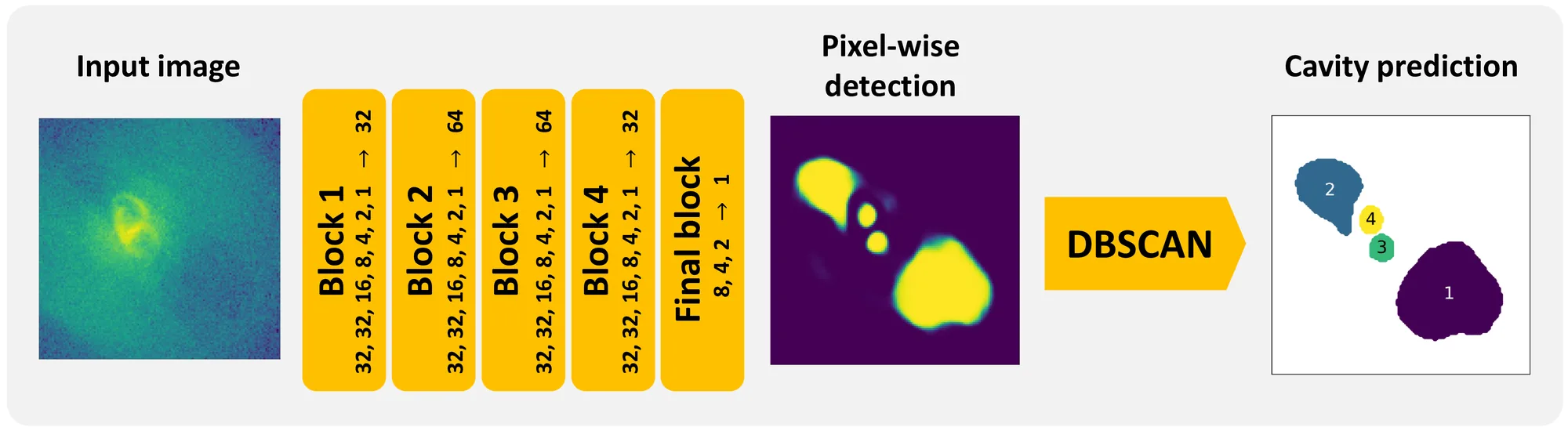
CADET is a Python pipeline using machine learning to detect and size X-ray cavities in massive early-type galaxies and clusters observed with Chandra. It is released as the Python package pycadet; the training and real-data application are described in Plšek et al. 2024. The pipeline provides an end-to-end workflow (data preparation, training/validation, and inference) and produces reproducible cavity catalogs with clear provenance.
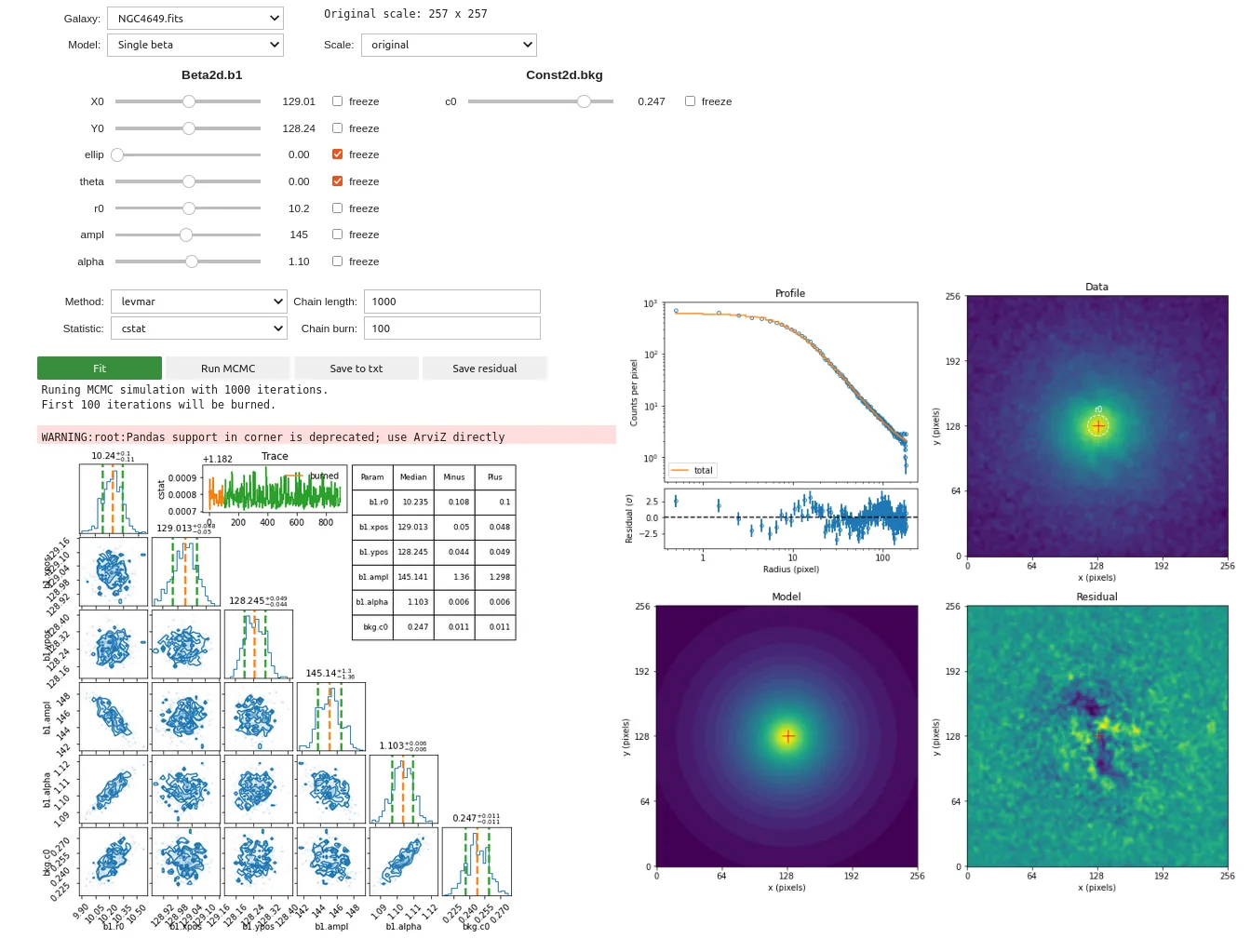
A Jupyter-based tool for fitting 2D surface-brightness distributions of galaxies with single or composite beta models and inspecting residuals. It lets you interactively adjust model parameters, visualize residual structure in real time, and export best-fit values. Combines Sherpa for modeling with ipywidgets for interactivity.
Interface of the Interactive beta modelling tool.
# Projects
## [Cavity Detection Tool (CADET)](https://github.com/tomasplsek/CADET)
CADET is a Python pipeline using machine learning to detect and size X-ray cavities in massive early-type galaxies and clusters observed with Chandra. It is released as the Python package [pycadet](https://pypi.org/project/pycadet/); the training and real-data application are described in [Plšek et al. 2024](https://academic.oup.com/mnras/article/527/2/3315/7339785). The pipeline provides an end-to-end workflow (data preparation, training/validation, and inference) and produces reproducible cavity catalogs with clear provenance.
[{: width="2000" height="550" loading="lazy"}](https://github.com/tomasplsek/CADET)
*Schematic of the CADET pipeline.*
{: .figure .figure-wide}
## [Interactive beta modelling](https://github.com/tomasplsek/Beta-modelling)
A Jupyter-based tool for fitting 2D surface-brightness distributions of galaxies with single or composite [beta models](https://ui.adsabs.harvard.edu/abs/1976A%26A....49..137C/abstract) and inspecting residuals. It lets you interactively adjust model parameters, visualize residual structure in real time, and export best-fit values. Combines [Sherpa](https://cxc.cfa.harvard.edu/sherpa/) for modeling with [ipywidgets](https://github.com/jupyter-widgets/ipywidgets) for interactivity.
[{: width="1344" height="1023" loading="lazy"}](https://github.com/tomasplsek/Beta-modelling)
*Interface of the Interactive beta modelling tool.*
{: .figure}
pongfirst to 5 · mouse, touch or ←/→ · Esc to quit

